Forging Virelia: The Hollow Bloom's Living World
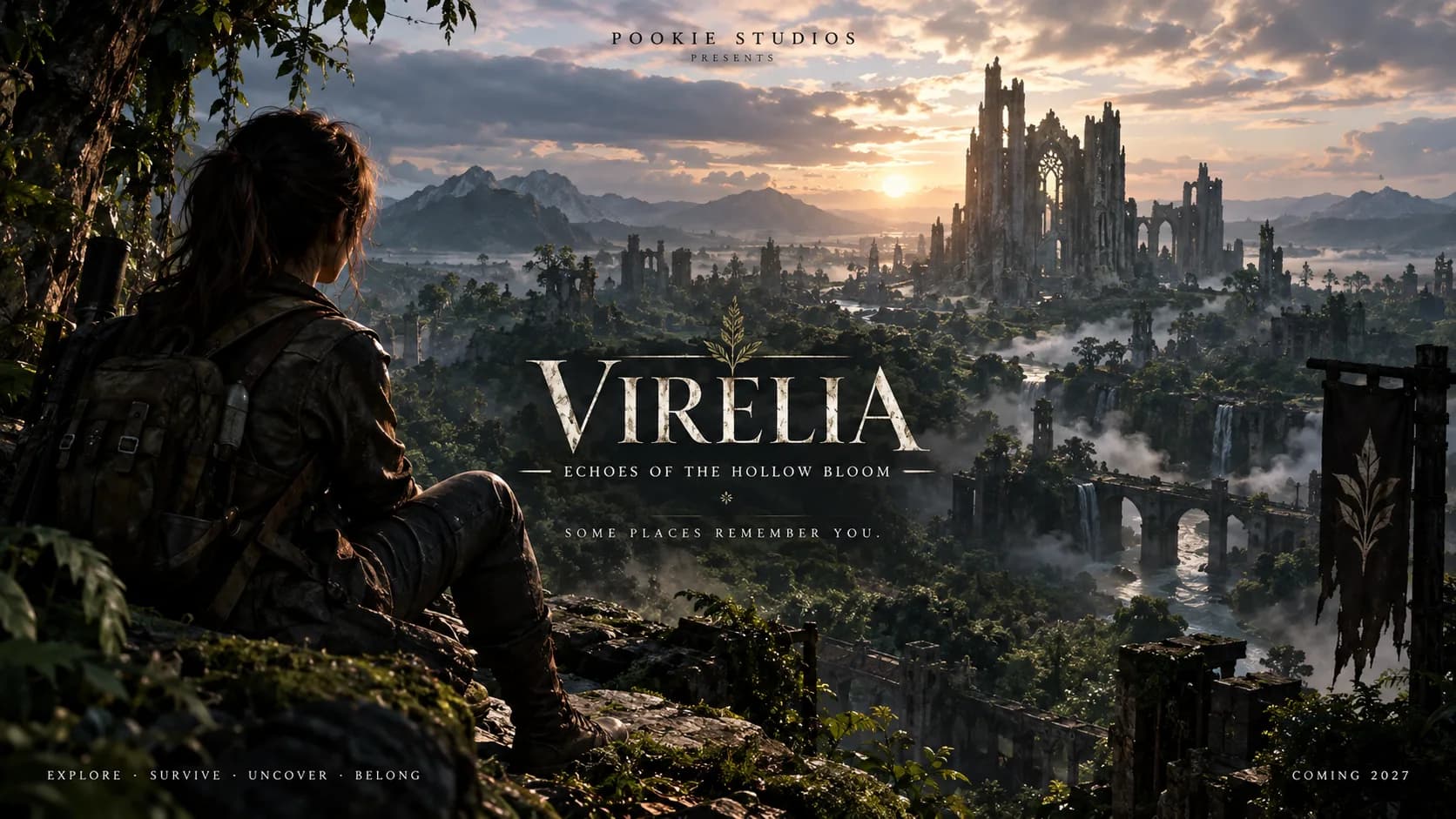
The Cathedral That Breathes
When we started Virelia, the mandate was simple: a world that feels alive without scripting every interaction. No trigger volumes. No quest markers telling the jungle what to do. The Hollow Bloom — the ancient floral consciousness at the heart of Virelia — had to actually react to the player.
Nanite Geometry, But Make It Organic
Traditional foliage systems rely on instanced meshes with wind shaders. For Virelia's cathedral ruins drowning in jungle, we needed geometry that is the structure. Nanite lets us author the cathedral as a single continuous mesh — 12M triangles of weathered stone, root-woven arches, and bloom-infested spires — then stream only what the camera sees.
The breakthrough: Nanite displacement on the world partition grid. Each 72m×72m tile carries its own displacement texture, driven by a compute shader that simulates root growth over in-game decades. The cathedral doesn't just look overgrown — it is overgrown, differently in every playthrough.
// Simplified root growth compute kernel
[numthreads(8, 8, 1)]
void CS_RootGrowth(uint3 DTid : SV_DispatchThreadID) {
    float2 uv = (DTid.xy + 0.5f) / TileResolution;
    float age = SampleTileAge(uv);
    float bloomInfluence = SampleBloomField(uv);

    // Reaction-diffusion for organic patterns
    float rootDensity = ReactionDiffusion(uv, age, bloomInfluence);

    // Output to displacement texture
    TileDisplacement[DTid.xy] = rootDensity * MaxDisplacement;
}
Ecosystem on the GPU
The Hollow Bloom's "memory" is a 4096×4096 render target — each pixel stores what the bloom has witnessed at that world coordinate. Player footsteps, combat, environmental changes — all write to this texture via append buffers. The ecosystem reads it back to drive:
- Fauna migration paths (herbivores avoid recent predator kills)
- Flora density (bloom spreads toward player activity)
- Audio ambience (birdsong fades where violence occurred)
- Quest state (the world remembers without quest flags)
This runs entirely on the GPU — zero CPU cost, scales with resolution, and persists across sessions via a single 64MB save blob.
Lumen GI That Tells a Story
Full Lumen GI isn't just pretty lighting — it's narrative. The Hollow Bloom emits a faint bioluminescence that bounces through the cathedral's stained glass, painting the jungle floor in shattered spectra. As the bloom grows, the color palette shifts. Players literally see the world changing in the indirect light.
We exposed Lumen's emissive intensity to the bloom's global state. No light baking. No manual placement. The cathedral glows because the bloom is glowing.
What's Next
- Spatial HRTF audio tied to bloom density (you hear the jungle thickening)
- Dynamic weather that affects root growth rates
- Multiplayer bloom synchronization — shared world memory across sessions
The Hollow Bloom remembers. Now the technology does too.
Dispatch from the engine room — Virelia team